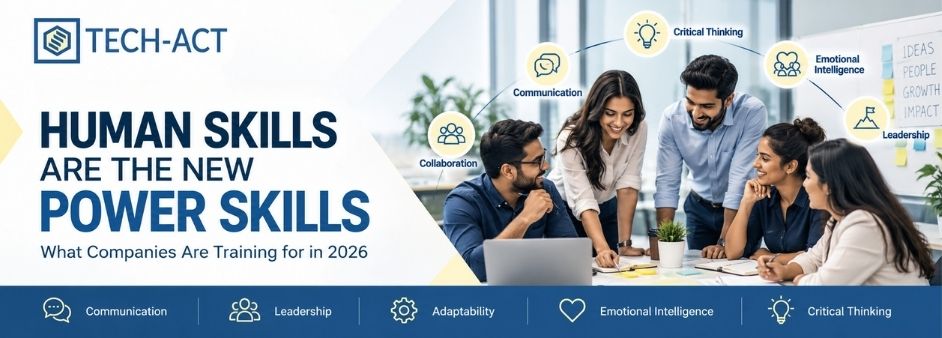
Human Skills Are the New Power Skills: What Companies Are Training for in 2026
Introduction
As artificial intelligence continues to automate routine tasks, the skills that make us uniquely human are becoming more valuable than ever. While technical expertise remains important, organizations are increasingly recognizing that long-term success depends on employees who can think critically, communicate effectively, solve complex problems, and lead with empathy.
In 2026, human skills, often referred to as power skills, are no longer considered “soft skills.” They are essential business capabilities that help teams innovate, collaborate, and adapt in a rapidly changing workplace.
Companies that prioritize these skills are building resilient, future-ready workforces capable of thriving alongside AI.
What Are Human Skills?
Human skills are interpersonal and cognitive abilities that enable employees to work effectively with others, make sound decisions, and navigate change.
Unlike technical skills, human skills are transferable across industries and roles, making them critical for long-term career growth.
Examples include:
- Critical thinking
- Communication
- Emotional intelligence
- Leadership
- Creativity
- Adaptability
- Collaboration
- Problem-solving
- Decision-making
- Conflict resolution
Why Human Skills Matter More Than Ever
AI can analyze data, automate workflows, and generate content, but it cannot replace human judgment, empathy, ethical decision-making, or relationship building.
Organizations are looking for employees who can:
- Lead cross-functional teams
- Solve complex business challenges
- Build strong customer relationships
- Drive innovation
- Navigate uncertainty
- Collaborate effectively with AI
As technology evolves, human skills become the competitive advantage.
The Top Human Skills Companies Are Prioritizing
- Critical Thinking
Employees must evaluate AI-generated information, question assumptions, and make informed decisions based on business context.
- Communication
Clear communication remains essential for collaboration, stakeholder management, and translating complex ideas into actionable outcomes.
- Emotional Intelligence
Leaders who understand emotions, build trust, and foster inclusive workplaces are better equipped to manage change and inspire teams.
- Adaptability
Technology and business priorities are evolving faster than ever. Employees who embrace continuous learning and adapt quickly remain valuable.
- Creativity and Innovation
While AI can generate ideas, humans provide originality, strategic thinking, and creative problem-solving that drive innovation.
- Leadership
Modern leaders need to guide hybrid teams, manage change, and create environments where people and AI work together effectively.
How Organizations Can Develop Human Skills
Building human skills requires ongoing learning rather than one-time training sessions.
Effective strategies include:
- Leadership development programs
- Scenario-based learning
- Coaching and mentoring
- Team collaboration workshops
- Communication training
- Design thinking sessions
- Cross-functional projects
- Peer learning and feedback
Combining these approaches creates meaningful learning experiences that translate into workplace performance.
Measuring Human Skills Development
Organizations can track progress using:
- Employee feedback
- 360-degree assessments
- Leadership evaluations
- Team collaboration metrics
- Learning completion rates
- Business performance indicators
- Employee engagement surveys
Regular measurement helps ensure training delivers measurable business value.
The Future of Workplace Learning
The future of Learning & Development will combine AI-powered learning with human-centered skill development.
While AI will continue to automate tasks, organizations will increasingly invest in helping employees develop the abilities that machines cannot replicate.
Businesses that balance technical expertise with strong human skills will be better positioned to innovate, lead change, and create lasting competitive advantage.
Conclusion
Technology may transform how we work, but human skills will determine how successfully organizations grow and innovate.
By investing in communication, leadership, emotional intelligence, creativity, and adaptability, companies can build resilient teams ready for the future of work.
In 2026, human skills aren’t optional, they’re the new power skills that drive business success.
FAQs
What are human skills in the workplace?
Human skills are interpersonal, cognitive, and behavioral abilities such as communication, leadership, emotional intelligence, critical thinking, and adaptability that help employees succeed in any role.
Why are human skills important in 2026?
As AI automates repetitive tasks, organizations increasingly rely on employees who can think critically, solve complex problems, collaborate effectively, and lead with empathy.
Are human skills the same as soft skills?
Many organizations now prefer the term power skills because these capabilities directly influence business performance, leadership, innovation, and employee engagement.
How can organizations develop human skills?
Organizations can build human skills through leadership development, coaching, mentoring, role-playing, collaborative projects, communication workshops, and continuous learning programs.
Which human skills are most in demand?
The most sought-after human skills include critical thinking, communication, emotional intelligence, adaptability, creativity, leadership, collaboration, and problem-solving.
Introduction
As artificial intelligence continues to automate routine tasks, the skills that make us uniquely human are becoming more valuable than ever. While technical expertise remains important, organizations are increasingly recognizing that long-term success depends on employees who can think critically, communicate effectively, solve complex problems, and lead with empathy.
In 2026, human skills, often referred to as power skills, are no longer considered “soft skills.” They are essential business capabilities that help teams innovate, collaborate, and adapt in a rapidly changing workplace.
Companies that prioritize these skills are building resilient, future-ready workforces capable of thriving alongside AI.
What Are Human Skills?
Human skills are interpersonal and cognitive abilities that enable employees to work effectively with others, make sound decisions, and navigate change.
Unlike technical skills, human skills are transferable across industries and roles, making them critical for long-term career growth.
Examples include:
- Critical thinking
- Communication
- Emotional intelligence
- Leadership
- Creativity
- Adaptability
- Collaboration
- Problem-solving
- Decision-making
- Conflict resolution
Why Human Skills Matter More Than Ever
AI can analyze data, automate workflows, and generate content, but it cannot replace human judgment, empathy, ethical decision-making, or relationship building.
Organizations are looking for employees who can:
- Lead cross-functional teams
- Solve complex business challenges
- Build strong customer relationships
- Drive innovation
- Navigate uncertainty
- Collaborate effectively with AI
As technology evolves, human skills become the competitive advantage.
The Top Human Skills Companies Are Prioritizing
- Critical Thinking
Employees must evaluate AI-generated information, question assumptions, and make informed decisions based on business context.
- Communication
Clear communication remains essential for collaboration, stakeholder management, and translating complex ideas into actionable outcomes.
- Emotional Intelligence
Leaders who understand emotions, build trust, and foster inclusive workplaces are better equipped to manage change and inspire teams.
- Adaptability
Technology and business priorities are evolving faster than ever. Employees who embrace continuous learning and adapt quickly remain valuable.
- Creativity and Innovation
While AI can generate ideas, humans provide originality, strategic thinking, and creative problem-solving that drive innovation.
- Leadership
Modern leaders need to guide hybrid teams, manage change, and create environments where people and AI work together effectively.
How Organizations Can Develop Human Skills
Building human skills requires ongoing learning rather than one-time training sessions.
Effective strategies include:
- Leadership development programs
- Scenario-based learning
- Coaching and mentoring
- Team collaboration workshops
- Communication training
- Design thinking sessions
- Cross-functional projects
- Peer learning and feedback
Combining these approaches creates meaningful learning experiences that translate into workplace performance.
Measuring Human Skills Development
Organizations can track progress using:
- Employee feedback
- 360-degree assessments
- Leadership evaluations
- Team collaboration metrics
- Learning completion rates
- Business performance indicators
- Employee engagement surveys
Regular measurement helps ensure training delivers measurable business value.
The Future of Workplace Learning
The future of Learning & Development will combine AI-powered learning with human-centered skill development.
While AI will continue to automate tasks, organizations will increasingly invest in helping employees develop the abilities that machines cannot replicate.
Businesses that balance technical expertise with strong human skills will be better positioned to innovate, lead change, and create lasting competitive advantage.
Conclusion
Technology may transform how we work, but human skills will determine how successfully organizations grow and innovate.
By investing in communication, leadership, emotional intelligence, creativity, and adaptability, companies can build resilient teams ready for the future of work.
In 2026, human skills aren’t optional, they’re the new power skills that drive business success.
FAQs
What are human skills in the workplace?
Human skills are interpersonal, cognitive, and behavioral abilities such as communication, leadership, emotional intelligence, critical thinking, and adaptability that help employees succeed in any role.
Why are human skills important in 2026?
As AI automates repetitive tasks, organizations increasingly rely on employees who can think critically, solve complex problems, collaborate effectively, and lead with empathy.
Are human skills the same as soft skills?
Many organizations now prefer the term power skills because these capabilities directly influence business performance, leadership, innovation, and employee engagement.
How can organizations develop human skills?
Organizations can build human skills through leadership development, coaching, mentoring, role-playing, collaborative projects, communication workshops, and continuous learning programs.
Which human skills are most in demand?
The most sought-after human skills include critical thinking, communication, emotional intelligence, adaptability, creativity, leadership, collaboration, and problem-solving.